

Duopra: full-duplex models that also execute tasks through a backend
Hugging Face papers
Duopra is a full-duplex interaction model that treats a backend as a tool and learns to invoke and revise tool requests during live conversation. It is trained in three stages including reinforcement learning rewarding timely, complete execution.
Source: huggingface.co ↗ · By CapyLaunch · checked 23 November 2026
Quick facts
| Type | Full-duplex speech model |
|---|---|
| Pass@1, direct tools | 47.7% on Full-Duplex-Bench v3 |
| Pass@1, DeepSeek backend | 49.3% on Full-Duplex-Bench v3 |
| Published | 2026-11-19 |
| Category | Research |
What is it
Duopra is a full-duplex speech model that can call tools and delegate tasks during a live conversation. It keeps natural turn-taking and handles interruptions while it works. The paper describes it as a model that treats a backend as a tool.
How it works
The model learns to invoke tool requests and revise them during the conversation. It is trained in three stages, including reinforcement learning that rewards timely and complete execution. The sources describe this training approach but do not give full implementation details.
Why it matters
Voice agents often split the conversation layer and the task layer into separate components. Duopra puts both in one model, which may make timing and argument corrections easier to manage. The paper reports that conversational agency and task agency can coexist.
For builders: If you build voice agents that must call tools mid-conversation, this paper describes how to handle timing and argument corrections more reliably than separate frontend and backend agents.
Who + how to try
For: Developers and builders of voice agents that need to call tools in the middle of a conversation.
Try:
FAQ
What does full-duplex mean here?
The model can listen and speak at the same time. It supports natural turn-taking, backchannels, and interruptions in real-time conversation.
How does Duopra differ from separate frontend and backend agents?
The draft says the backend is treated as a tool that the model invokes and revises during live conversation. The sources do not compare speed or accuracy against specific separate-agent setups.
Where can I try it or read more?
The paper page links to a project and demo page, the code repository, and the model on Hugging Face.
Also new this week in Research
All 1 Research stories →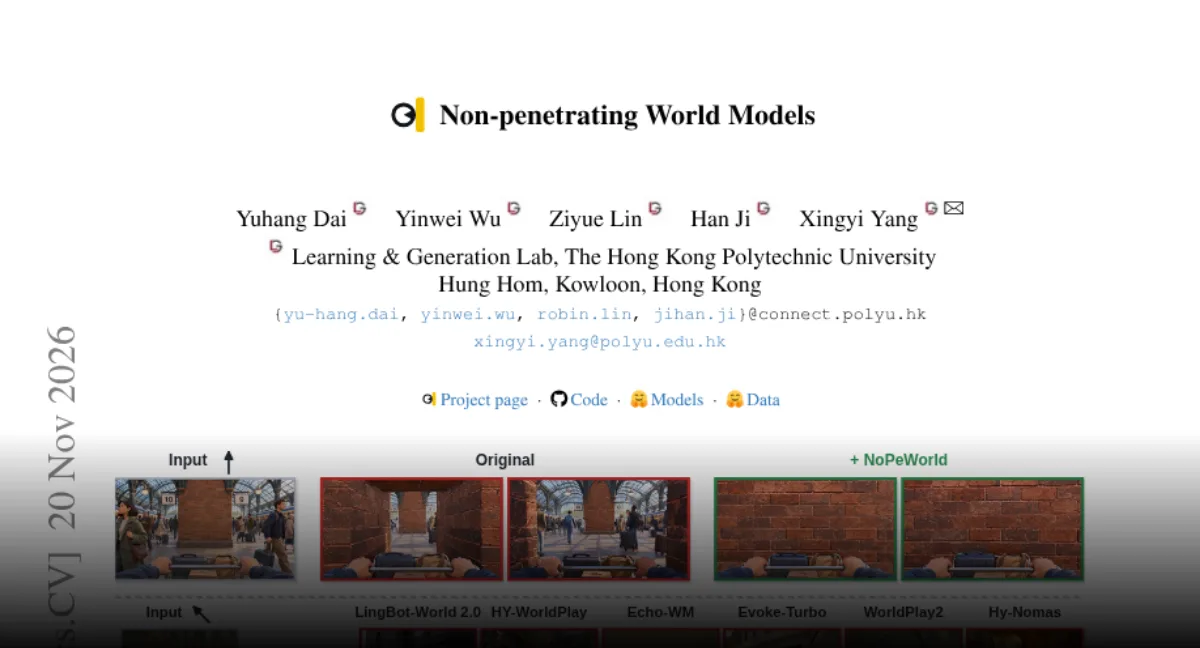
NoPeWorld: stopping object penetration in video world models
Researchers introduce NoPeBench to test how video world models handle obstacles and NoPeWorld, a small head trained on frozen diffusion transformer states that flags and replaces penetrating actions. Reported violation rate drops from 74% to 16% across six models.
For builders: If your product uses video world models for simulation or interaction, a lightweight safety check on hidden states may reduce physically impossible outputs without retraining the base model.
Spotted a mistake? Email hello@capylaunch.com and we will correct it. How we make CapyLaunch News.