

Embodied AI fails the mirror test: reflections break robot policies
Hugging Face papers
RoboDojo-Mirror, a new benchmark, shows that robot manipulation policies lose success rates when mirrors appear in the scene, with drops of 10.8 to 56.7 percentage points across five tested policies.
Source: huggingface.co ↗ · By CapyLaunch
What happened
RoboDojo-Mirror, a new benchmark, shows that robot manipulation policies lose success rates when mirrors appear in the scene, with drops of 10.8 to 56.7 percentage points across five tested policies.
Why it matters
For builders: If your robot or vision-based product operates near reflective surfaces, test for phantom targeting, since reflections can cut task success sharply.
Also new this week in Research
All 21 Research stories →
ThinkMorph-SSL trains multimodal models to reason with images
A new paper introduces ThinkMorph-SSL, a two-stage training method that uses images as their own supervision through visual pretext tasks like colorization and denoising. The authors report an average gain of 11.33 accuracy points across twelve benchmarks over the base model.

ACAP: asynchronous coding agents for robot control
ACAP organises a robot as a team of persistent coding agents, each controlling part of the body, with a hyper-agent coordinating dependencies. Across 72 real-world rollouts it cut task time by 28.2% versus a single-agent policy.

NightWatch: proactive perception for computer-use agents
NightWatch is a plug-and-play framework that adds continuous screen monitoring to any computer-use agent via a lightweight 0.8B model, aiming to cut stale actions caused by slow VLM inference on changing interfaces.
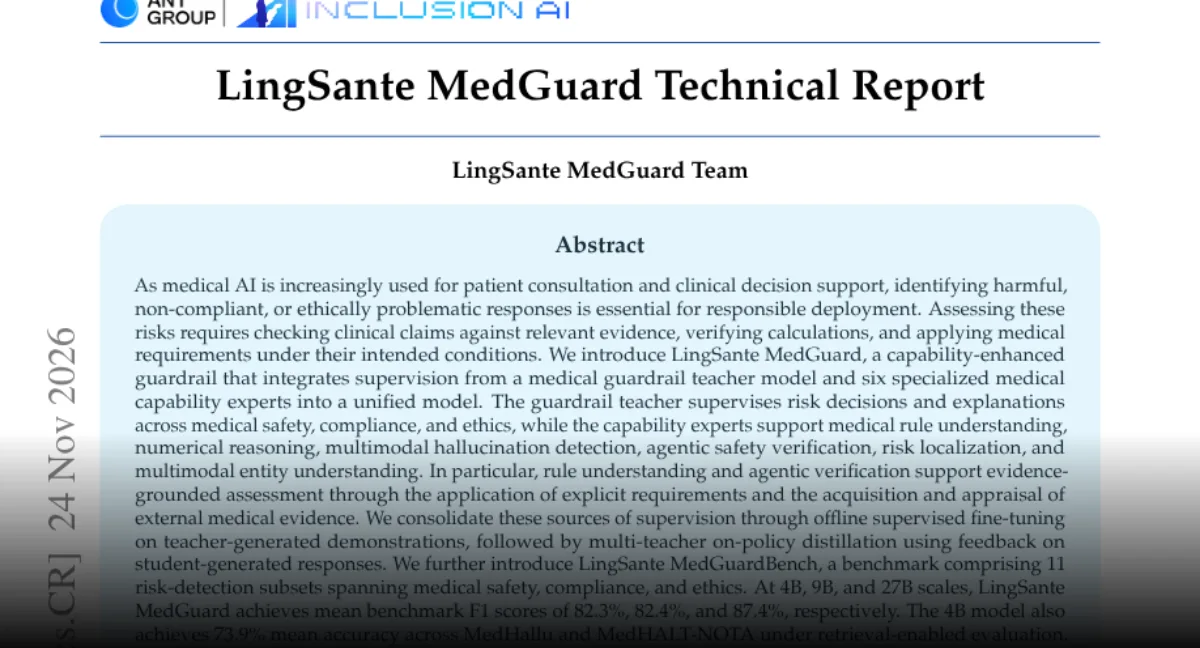
LingSante MedGuard: a medical AI guardrail model
LingSante MedGuard is a guardrail model for medical AI that checks responses for safety, compliance and ethics risks, combining a teacher model with six capability experts, and comes with a new 11-category benchmark.
Spotted a mistake? Email hello@capylaunch.com and we will correct it. How we make CapyLaunch TLDR News.