

Historian uses GPT-6.2 Astra to identify author of 1808 sketchbook
Mark Humphries (Yale history professor)
Yale history professor Mark Humphries reports that GPT-6.2 Astra autonomously identified the creator of an anonymous 1808 sketchbook at Yale's Beinecke Library in about 22 minutes, using public sources. The model also located a little-known archival source that supported its hypothesis.
Source: simonwillison.net ↗ · By CapyLaunch
Quick facts
| Model | GPT-6.2 Astra |
|---|---|
| Task | Identify author of anonymous 1808 sketchbook |
| Held at | Yale's Beinecke Library |
| Time taken | About 22 minutes |
| Sources | Publicly available primary and secondary sources |
| Reported by | Mark Humphries, history professor |
What is it
A case study from Yale history professor Mark Humphries. He reports that GPT-6.2 Astra, with only minimal prompting, identified the creator of an anonymous 1808 sketchbook held at Yale's Beinecke Library. The model worked autonomously and used publicly available primary and secondary sources.
How it works
The model searched public sources and found a diary reference to a visit by the vicomte de Chabot, dated five days before a date in the sketchbook at a nearby river. It suggested that Chabot's travel journal, available only by order from Cleveland State University, might confirm the sketchbook was his work.
Why it matters
The model finished the task in about 22 minutes. It also found a little-known source in a paper archive and predicted it would support its hypothesis, which it did. For builders of research or retrieval assistants, this is an example of multi-step research over public archives.
For builders: It is a concrete example of an LLM doing multi-step research over public archives, useful for anyone building research or retrieval assistants.
Who + how to try
For: Developers, indie makers and founders building research or retrieval assistants.
Try:
https://simonwillison.net/2026/Nov/24/astra-historical-mystery/
FAQ
What did the model actually do?
With minimal prompting, it autonomously identified the creator of an anonymous 1808 sketchbook at Yale's Beinecke Library, using publicly available primary and secondary sources, in about 22 minutes.
How did it find the answer?
It discovered a little known source in a paper archive and predicted it would prove its hypothesis if examined. A diary reference to a visit by the vicomte de Chabot, five days before a date in the sketchbook, pointed to his travel journal as possible confirmation.
Is the new source important on its own?
Humphries says the source turns out to be a major find that will interest both Canadian and fur trade historians.
Will this replace historians?
Humphries expects a crisis of confidence as historians respond to agentic systems. He notes that historians reinterpret the past and write works closer to philosophy and literature, so humanity is a requirement for historical writing.
Also new this week in Models
All 7 Models stories →
New model on Hugging Face: inclusionAI/Ling-3.2-air
inclusionAI has published Ling-3.2-air on Hugging Face, a safetensors model using the bailing_moe_v3_vl architecture with custom code and FP8 weights. It has 151 likes and 733 downloads so far.
New on Hugging Face: AtomicChat Inkling-2-Mini-Uncensored-GGUF
AtomicChat published Inkling-2-Mini-Uncensored-GGUF, an image-text-to-text model in GGUF format for llama.cpp. It has 680 likes and about 329,000 downloads.
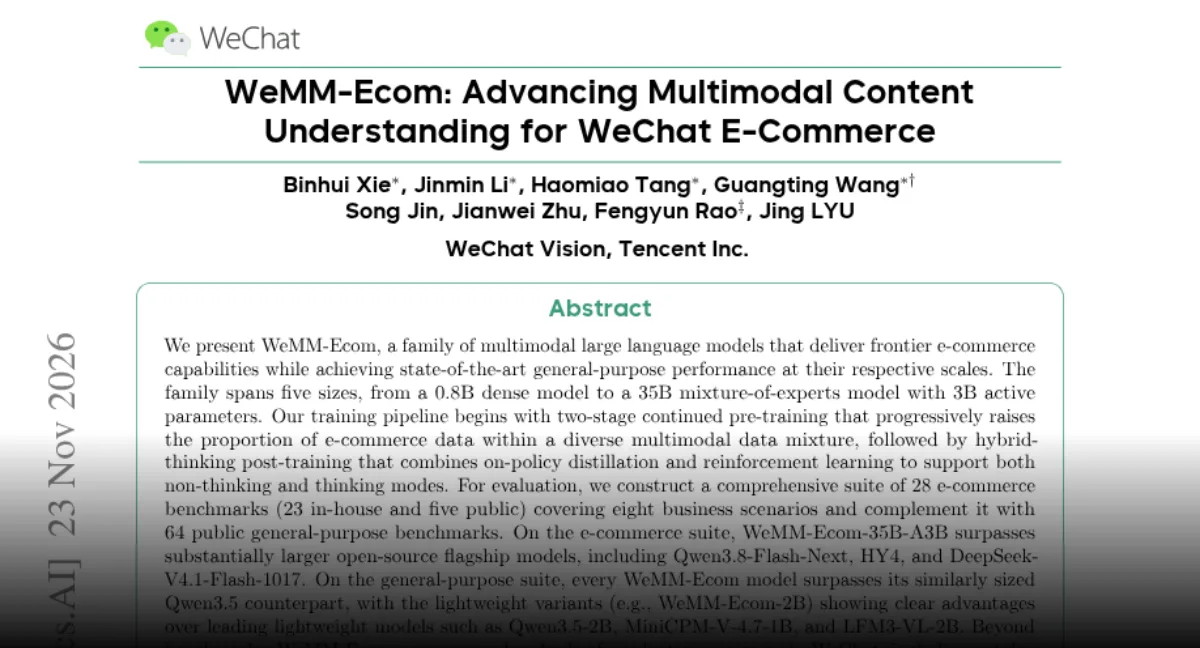
WeMM-Ecom: a family of multimodal models for e-commerce from WeChat
Researchers released WeMM-Ecom, five multimodal language models from 0.8B to 35B parameters, built for e-commerce tasks while also competing on general benchmarks. The paper reports the 35B mixture-of-experts variant beats larger open-source flagship models on its 28-benchmark e-commerce suite.
Fireship: Google's Gemini 4 Neon outscores its own newer flagship
A Fireship video covers Google's Gemini 4 Neon, a mid-tier model that the video says outscores its own three-week-old flagship.
Spotted a mistake? Email hello@capylaunch.com and we will correct it. How we make CapyLaunch TLDR News.