

Hugging Face blog: RoboTrack, point tracking for real-world robot manipulation
Ai2 (allenai) via Hugging Face
Hugging Face published a blog post from allenai introducing RoboTrack, a point tracking approach for robotic manipulation in real-world settings.
Source: huggingface.co ↗ · By CapyLaunch
Quick facts
| Published | November 23, 2026 |
|---|---|
| Benchmark videos | 307 videos, 2,522 point tracks |
| Source datasets | DROID, Ego-Exo4D, MolmoAct 2, EgoVerse |
| Training dataset | RoboTrack-15M, built on MolmoSpaces |
| Models | RoboTracker (fine-tuned AllTracker), RoboTracker-Warp (from CoWTracker) |
| Results | RoboTracker-Warp achieves state-of-the-art on four of five benchmarks evaluated |
What is it
RoboTrack is a benchmark and training data suite for point tracking in real-world robotic manipulation. It includes RoboTrack-Bench, a set of 307 human-annotated videos with 2,522 point tracks, and RoboTrack-15M, a synthetic training dataset built with MolmoSpaces. The release also includes two new point tracking models, RoboTracker and RoboTracker-Warp.
How it works
A point tracker takes a location in one video frame and estimates where that point appears in later frames, including when it is occluded and when it reappears. RoboTrack-15M generates dense point tracks from simulated robot manipulation trajectories, and adding it to an existing tracker's training improves performance on real manipulation video. Every track in the benchmark was annotated and then checked by a second group of human annotators.
Why it matters
Robots need to follow the positions of their grippers and objects through an interaction. The authors found that leading trackers score much lower on RoboTrack-Bench than on existing robotics benchmarks, so current results may not hold in varied real scenes. Builders evaluating trackers for manipulation tasks now have a harder, more realistic test set.
For builders: If you build robotics software, RoboTrack offers a tracking method to evaluate for manipulation tasks.
Who + how to try
For: Developers and researchers who build robotics software and want to evaluate or train point trackers for manipulation tasks.
Try:
FAQ
What is point tracking?
Given a location in one video frame, a tracker estimates where that same point appears in subsequent frames, when it is occluded, and where it reappears.
Why was RoboTrack-Bench created?
The authors wanted to see whether tracker results on existing robotics benchmarks hold up across the varied scenes, viewpoints, and object interactions robots meet in practice.
Does the simulated training data help?
Adding RoboTrack-15M to an existing tracker's training improves performance on real manipulation video, with gains extending to other tracking benchmarks.
What is RoboTrack-Bench's multi-view subset?
It contains 33 video pairs recorded simultaneously from two cameras, with the same physical points annotated in both views and synchronized across frames.
Also new this week in Research
All 8 Research stories →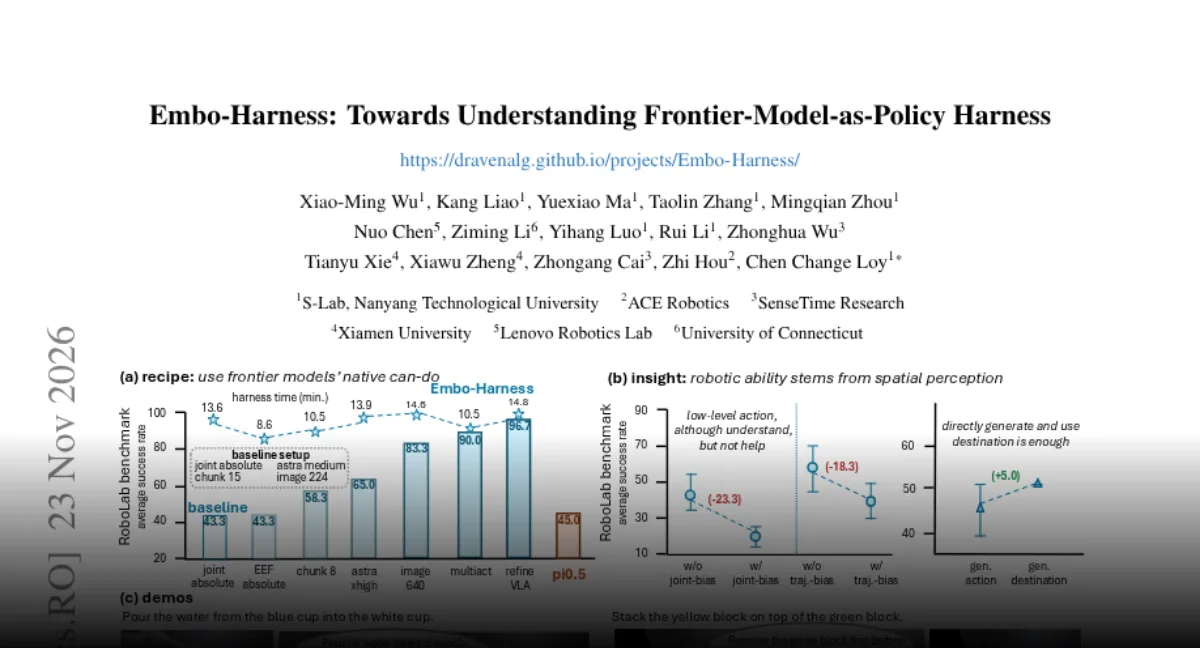
Embo-Harness: study of frontier models used directly as robot control policies
Embo-Harness is a framework for studying how frontier multimodal models can act as robot policies inside closed-loop agent loops. The authors report an 83.3% success rate on RoboLab-120, 26.2 points above the strongest reported baseline, and 15 of 20 zero-shot real-world trials.

SynthDCB: benchmark for device control across home, car and phone
SynthDCB is a device-control benchmark built by converting device behaviours into executable components, covering 114 device classes and 1,166 functions. The authors evaluated 22 models on 2,560 test tasks, with the best reaching 88.8% mean Pass@1.
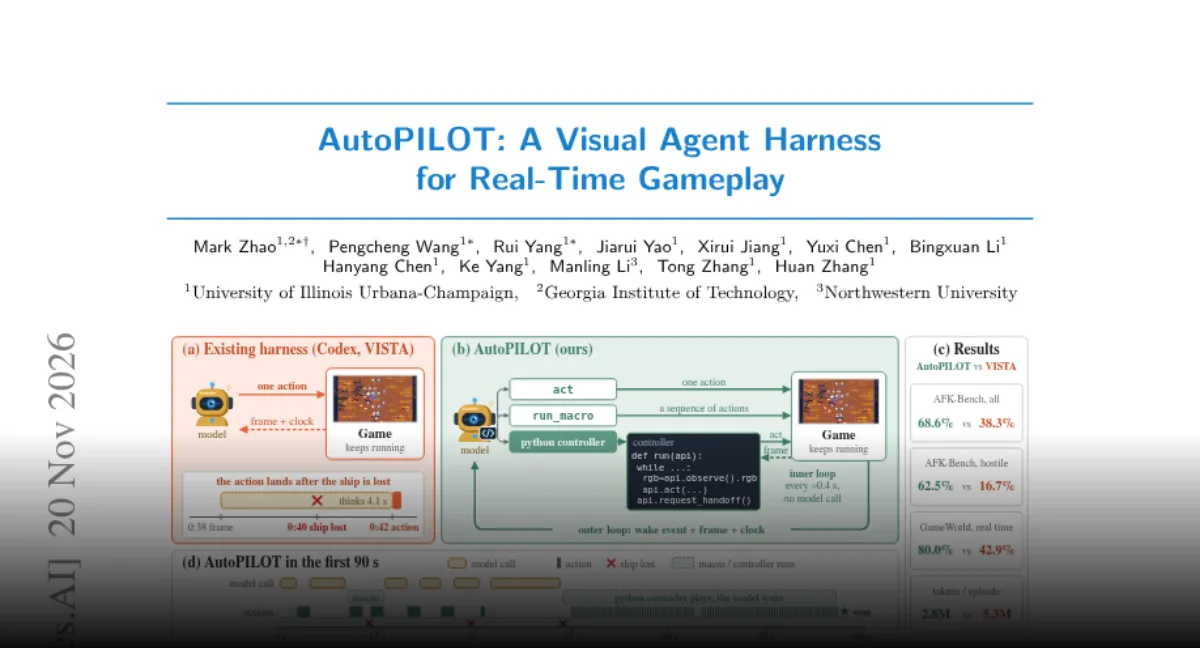
AutoPILOT: a harness that lets agents keep playing real-time games
Researchers present AutoPILOT, a visual agent harness where one model call can start a closed-loop controller that plays without further model calls. On the AFK-Bench real-time game set, it reports 68.6% success against 38.3% for VISTA using GPT-6.1 Sol.

MemOnce: a memory architecture aiming for linear-time long-context use
MemOnce caches a small set of final-layer hidden states as compact memory and decodes them back into KV caches on demand. The authors claim this reduces GPU memory growth and gives linear-time complexity for long, continual interactions.
Spotted a mistake? Email hello@capylaunch.com and we will correct it. How we make CapyLaunch News.