

SynthDCB: benchmark for device control across home, car and phone
Zichen Zhu (Hugging Face paper page)
SynthDCB is a device-control benchmark built by converting device behaviours into executable components, covering 114 device classes and 1,166 functions. The authors evaluated 22 models on 2,560 test tasks, with the best reaching 88.8% mean Pass@1.
Source: huggingface.co ↗ · By CapyLaunch
Quick facts
| Domains | Home, car and phone |
|---|---|
| Device classes | 114 |
| Functions | 1,166 |
| Models evaluated | 22 |
| Test tasks | 2,560 across 32 task subtypes |
| Best mean Pass@1 | 88.8% |
| Instruction styles | 8 |
What is it
SynthDCB is a benchmark for testing AI agents that control devices in homes, cars and phones. It is built by turning device behaviours into executable components. It covers 114 device classes and 1,166 functions.
How it works
The benchmark is produced by an automated harness called World Distillation. It turns device knowledge into executable worlds and verified, deterministic tasks. Evaluation uses more than 20 diagnostic metrics covering task outcome, state correctness and execution behaviour. Failed first attempts are sorted into 12 error categories across 4 groups.
Why it matters
If you are building agents that control smart devices or apps, you can test your agent before deployment. The benchmark gives you executable environments and tool-call traces. Across 22 evaluated models on 2,560 test tasks, the best reached 88.8% mean Pass@1.
For builders: Useful if you are building agents that control smart devices or apps, since it provides executable environments and tool-call traces for testing your agent before deployment.
Who + how to try
For: Developers, indie makers and founders building agents that control smart devices or apps.
Try:
FAQ
What does SynthDCB measure?
It evaluates an agent's environment awareness and device control. It supports 8 instruction styles and reports more than 20 diagnostic metrics on task outcomes, state correctness and execution behaviour.
How well did models perform?
Across 22 models on 2,560 test tasks, the best reached 88.8% mean Pass@1.
Is the dataset and code available?
The paper page says the complete dataset and code were released, and readers are invited to try SynthDCB and share feedback.
How are failures analysed?
All failed first attempts are analysed using 12 error categories across 4 groups, which reveals capability gaps and distinct failure patterns across models.
Also new this week in Research
All 8 Research stories →
Hugging Face blog: RoboTrack, point tracking for real-world robot manipulation
Hugging Face published a blog post from allenai introducing RoboTrack, a point tracking approach for robotic manipulation in real-world settings.
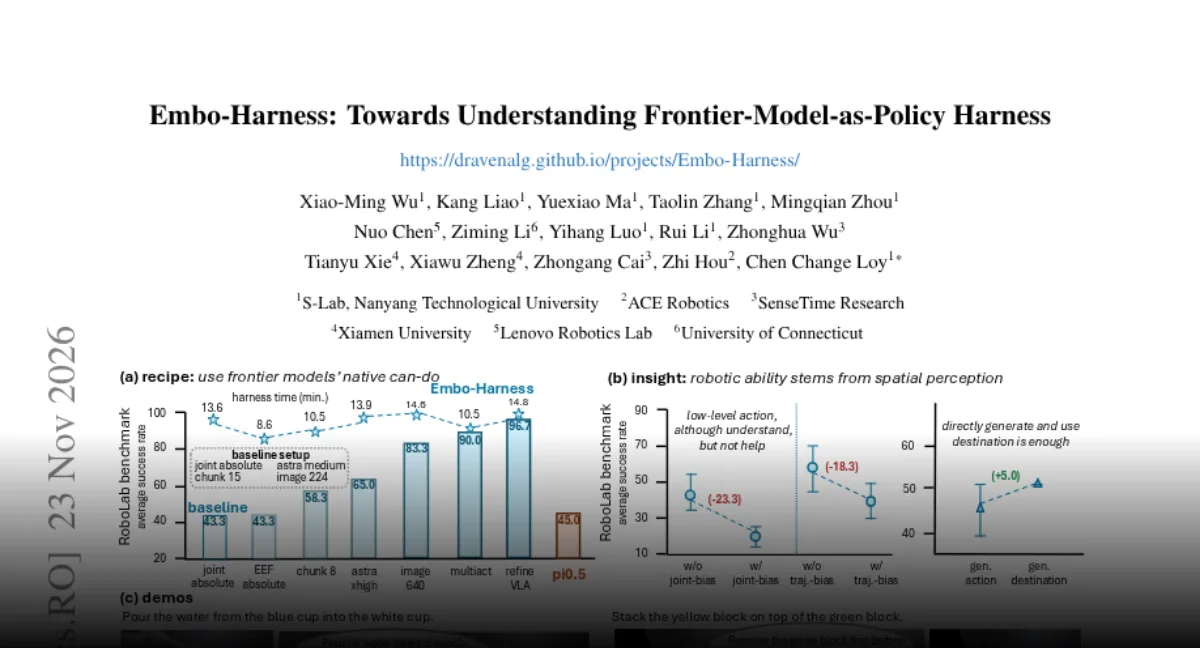
Embo-Harness: study of frontier models used directly as robot control policies
Embo-Harness is a framework for studying how frontier multimodal models can act as robot policies inside closed-loop agent loops. The authors report an 83.3% success rate on RoboLab-120, 26.2 points above the strongest reported baseline, and 15 of 20 zero-shot real-world trials.
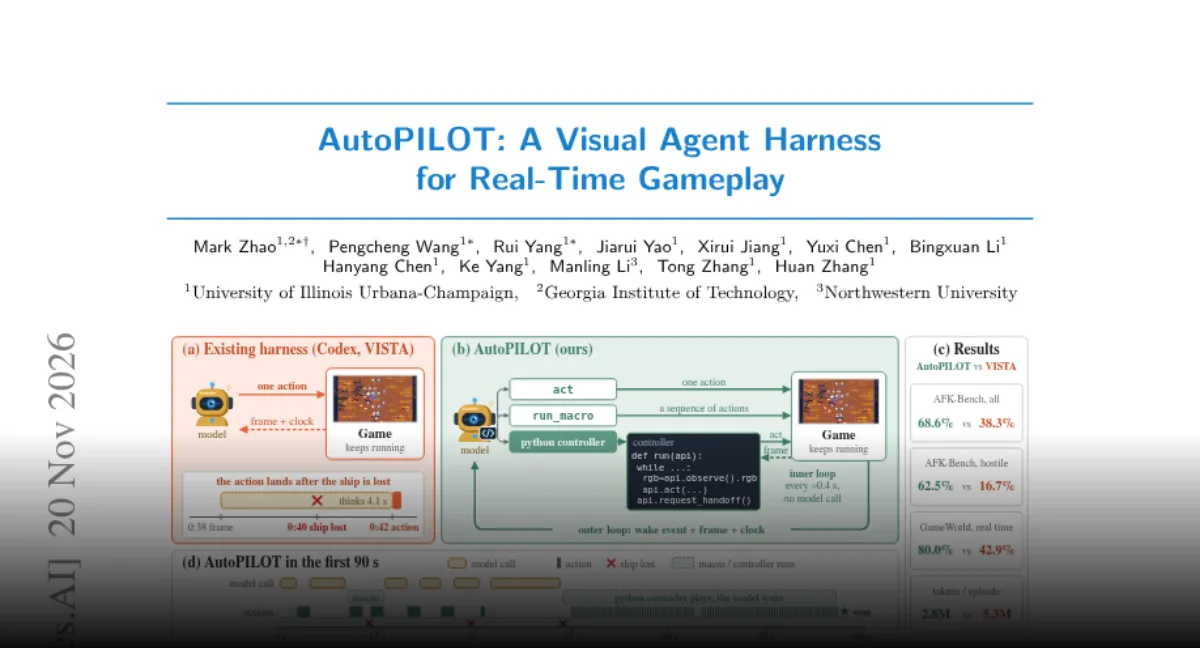
AutoPILOT: a harness that lets agents keep playing real-time games
Researchers present AutoPILOT, a visual agent harness where one model call can start a closed-loop controller that plays without further model calls. On the AFK-Bench real-time game set, it reports 68.6% success against 38.3% for VISTA using GPT-6.1 Sol.

MemOnce: a memory architecture aiming for linear-time long-context use
MemOnce caches a small set of final-layer hidden states as compact memory and decodes them back into KV caches on demand. The authors claim this reduces GPU memory growth and gives linear-time complexity for long, continual interactions.
Spotted a mistake? Email hello@capylaunch.com and we will correct it. How we make CapyLaunch News.