

Antom 3-in-1 Transformer: a 7B payment risk foundation model
Ant International
Ant International describes a roughly 7B-parameter payment foundation model combining sequence, tabular and graph representations for payment risk detection. Its paper reports a 37.88% drop in loss rate versus an online baseline in a four-month live test.
Source: huggingface.co ↗ · By CapyLaunch
Quick facts
| Maker | Ant International |
|---|---|
| Total parameters | About 7B |
| Activated per route | About 1.7B |
| Label usage | 25% of labels |
| Loss rate reduction | 37.88% vs XGB-Online in 4-month test |
| Weights released | No, withheld to limit fraud evasion |
What is it
Antom 3-in-1 Transformer is a payment foundation model from Ant International with about 7B total parameters and about 1.7B activated per task route. It combines sequence data (transaction histories), tabular data (features) and graph data (relational links) in one backbone. It is built for payment risk detection.
How it works
The model fuses sequence, tabular and graph representations into a single backbone using task-conditioned fusion. Pretraining on behavioural data is used before fine-tuning to each business. The approach aims to reduce how many labelled examples a team needs.
Why it matters
The paper reports that pretraining improves the target business metric by 34.5% over the same architecture trained from scratch. With only 25% of labels, it beats the full-label scratch baseline in AP and Recall@0.5 across merchant domains. In a 4-month online test on a billion-scale payment platform, it cut the overall loss rate by 37.88% versus XGB-Online at the same 0.5% intervention budget.
For builders: If you build fraud or risk detection, the paper shows pretraining on behavioural data can cut label needs to 25% while still beating a full-label baseline.
Who + how to try
For: Teams that build fraud or payment risk detection systems, especially multi-modal data in fintech and risk control.
Try:
FAQ
Can I download the model weights?
No. The source says no model weights are released because a payment risk model could help fraudsters evade detection. Architecture, training configs and dataset construction are shared only with invited third parties.
How much did pretraining help?
The paper says pretraining improves the target business metric by 34.5% over the same architecture trained from scratch.
Does it need full labels to beat the baseline?
No. With only 25% of labels it beats the full-label scratch baseline in AP and Recall@0.5 across merchant domains, according to the paper.
Also new this week in Research
All 16 Research stories →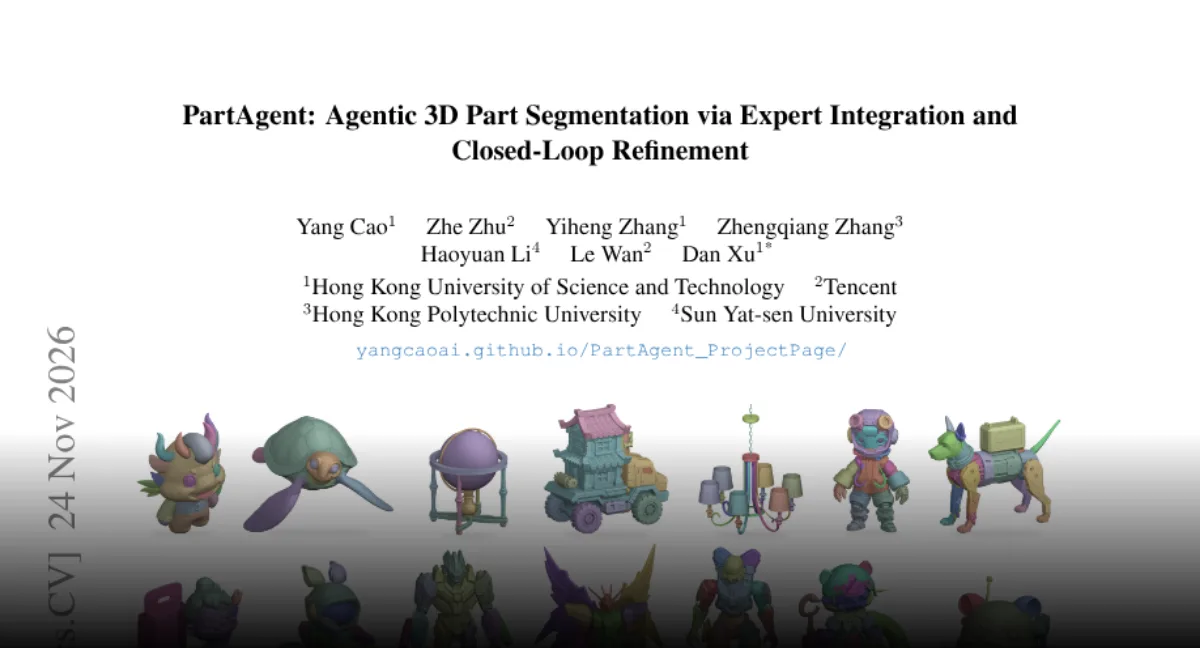
PartAgent: training-free agentic 3D part segmentation
PartAgent combines 3D expert region proposals with 2D semantic evidence in a training-free agent that refines part segmentations in a closed loop, reaching 68.41 mIoU on PartObjaverse-Tiny-WT.
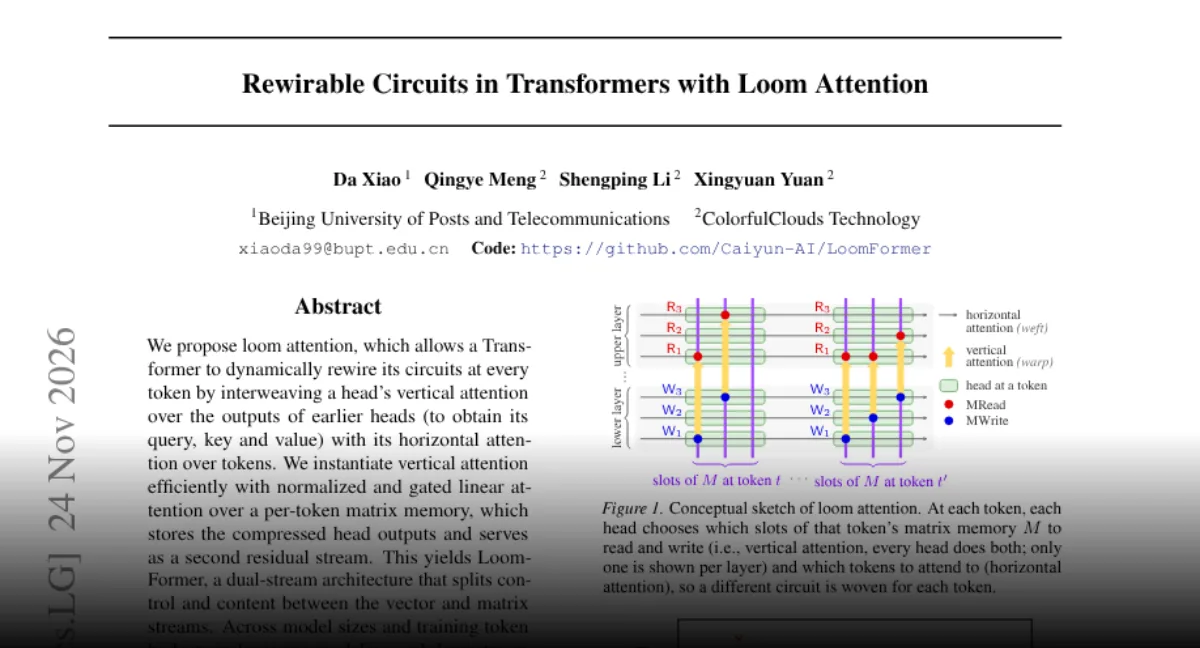
Loom attention lets Transformers rewire circuits per token
Researchers propose loom attention, letting a Transformer rewire its circuits at every token using a second matrix-memory stream. The resulting LoomFormer reportedly matches models trained with over 3x the compute at 2% extra FLOPs in their tests.

PenGPT: a generative transformer for handwriting and sketches
PenGPT is a generative transformer model for producing handwriting and sketches, shared on a personal blog and discussed on Hacker News.

S-Mind adds multi-view 3D geometry to multimodal LLMs
S-Mind internalizes multi-view geometry in an MLLM through a compact set of spatial tokens that hold a fused 3D scene. It reports gains of up to 22.26 points on Qwen3.5 backbones across four spatial benchmarks.
Spotted a mistake? Email hello@capylaunch.com and we will correct it. How we make CapyLaunch TLDR News.