

PartAgent: training-free agentic 3D part segmentation
Yang Cao and co-authors
PartAgent combines 3D expert region proposals with 2D semantic evidence in a training-free agent that refines part segmentations in a closed loop, reaching 68.41 mIoU on PartObjaverse-Tiny-WT.
Source: huggingface.co ↗ · By CapyLaunch
Quick facts
| Type | Training-free agentic framework |
|---|---|
| Benchmark | PartObjaverse-Tiny-WT: 68.41 mIoU |
| Margin | 8.53 points above strongest competing method |
| Four-dataset mean | 69.36 mIoU, 7.28 points above best competing mean |
| Datasets | 3DCoMPaT200, PartNeXt, PartNetE, PartObjaverse-Tiny |
What is it
PartAgent is a training-free agentic framework for 3D part segmentation. It splits a 3D object into meaningful parts by combining regions from a pretrained 3D expert with semantic evidence from a 2D expert. The paper reports 68.41 mIoU on PartObjaverse-Tiny-WT.
How it works
A structural-semantic module links 3D expert region proposals to multiview 2D semantic evidence through image-to-surface correspondences. This builds part partitions at several granularities. A closed-loop module then inspects the current partition, repairs evidence, composes or reselects parts, and verifies each change before using it for later decisions.
Why it matters
Builders who segment 3D assets can use an existing 3D and 2D expert pipeline without fine-tuning a model. The paper says it beats the strongest competing method by 8.53 points on PartObjaverse-Tiny-WT. It also reports the highest mIoU on each of four datasets, with a four-dataset average of 69.36.
For builders: If you segment 3D assets, PartAgent offers a training-free pipeline that combines existing 3D and 2D experts without fine-tuning.
Who + how to try
For: Developers, indie makers and founders who work with 3D object segmentation.
Try:
FAQ
Does PartAgent need training?
No. The paper describes it as a training-free framework that builds on existing 3D and 2D experts.
Which datasets were tested?
The paper reports results on 3DCoMPaT200, PartNeXt, PartNetE and PartObjaverse-Tiny, with the highest mIoU on each.
Where can I find the code?
The paper page links to a public code repository and a project page.
Also new this week in Research
All 16 Research stories →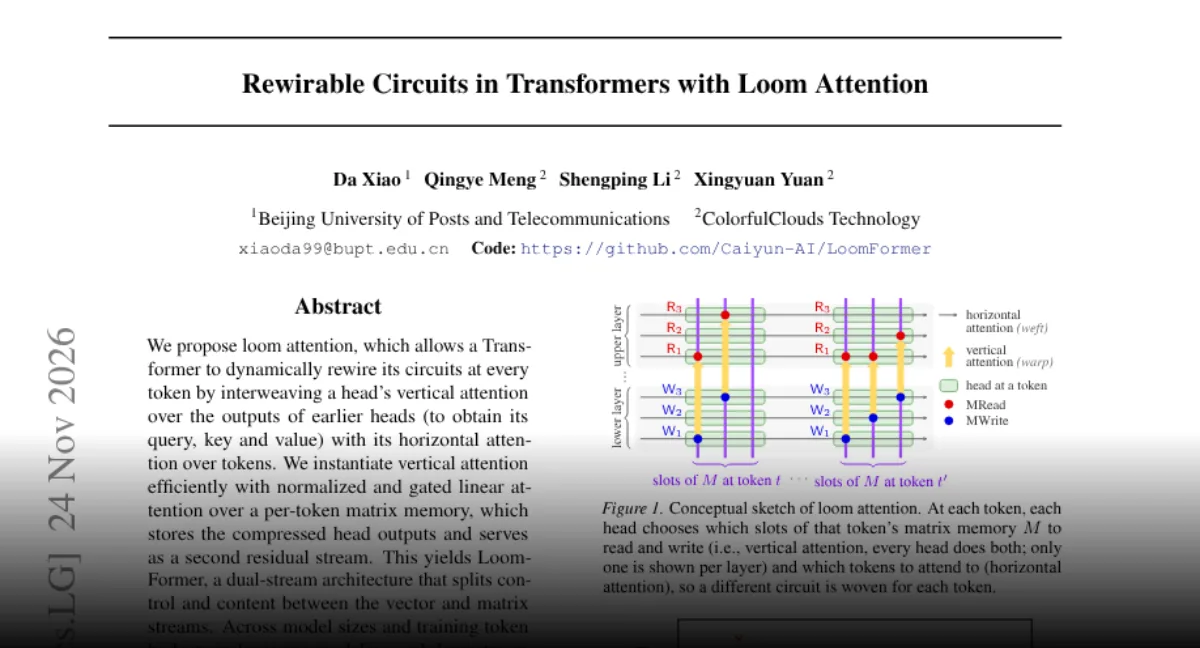
Loom attention lets Transformers rewire circuits per token
Researchers propose loom attention, letting a Transformer rewire its circuits at every token using a second matrix-memory stream. The resulting LoomFormer reportedly matches models trained with over 3x the compute at 2% extra FLOPs in their tests.

PenGPT: a generative transformer for handwriting and sketches
PenGPT is a generative transformer model for producing handwriting and sketches, shared on a personal blog and discussed on Hacker News.

S-Mind adds multi-view 3D geometry to multimodal LLMs
S-Mind internalizes multi-view geometry in an MLLM through a compact set of spatial tokens that hold a fused 3D scene. It reports gains of up to 22.26 points on Qwen3.5 backbones across four spatial benchmarks.
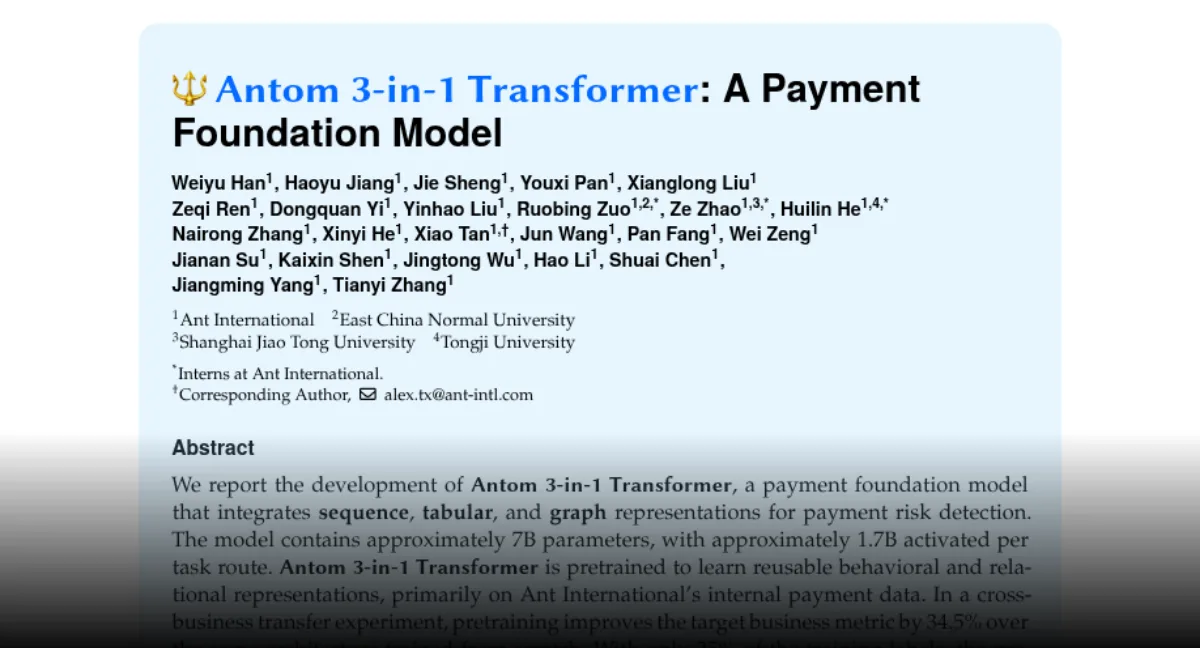
Antom 3-in-1 Transformer: a 7B payment risk foundation model
Ant International describes a roughly 7B-parameter payment foundation model combining sequence, tabular and graph representations for payment risk detection. Its paper reports a 37.88% drop in loss rate versus an online baseline in a four-month live test.
Spotted a mistake? Email hello@capylaunch.com and we will correct it. How we make CapyLaunch TLDR News.