

DocSEAM: cross-page encoding for multi-page document VQA
MMLab@NTU (Hoang-Nhat Nguyen, Chen Change Loy)
Researchers propose DocSEAM, a lightweight module that lets a vision-language model use content from neighboring pages when reading multi-page documents. A 9B-parameter model using it reports state-of-the-art results among open-weight models up to 10B on five multi-page document VQA benchmarks.
Source: huggingface.co ↗ · By CapyLaunch
Quick facts
| Model size | 9B parameters |
|---|---|
| Benchmarks | Five multi-page document VQA benchmarks |
| Result | State-of-the-art among evaluated open-weight models up to 10B |
| Visual token count | Unchanged by the module |
| Paper | arXiv 2611.34420, published 2026-11-25 |
What is it
DocSEAM is a lightweight module for vision-language models that read multi-page documents. It lets each page use content from its two neighboring pages. The researchers present it as a way to reduce the gap that appears at page boundaries when each page is encoded alone.
How it works
For each page, DocSEAM forms a local triplet with its two neighbors. It applies center-anchored masked self-attention with directional salience gates to fuse neighbor information, then returns only the enriched center-page tokens. It sits between a pretrained vision encoder and the language model, and the model is trained with a supervised cross-page warm-up followed by multi-page fine-tuning with DocSEAM frozen.
Why it matters
Multi-page document models usually encode each page in isolation, so the language model has to reason over page features that never saw adjacent pages. DocSEAM adds cross-page context without adding visual tokens, so the token count and cost stay the same. The sources also say it reduces sensitivity to where page boundaries fall and improves cross-page span localization.
For builders: If you process multi-page PDFs or scanned documents, page-boundary context may matter more than per-page encoding suggests; the module adds no visual tokens, so cost stays the same.
Who + how to try
For: Developers and teams working on multi-page PDF or scanned document question answering with vision-language models.
Try:
FAQ
Does DocSEAM increase inference cost?
The module adds no visual tokens, and the visual token count stays unchanged, so the cost is the same as the underlying per-page encoding.
What does it change compared with per-page encoding?
Each page's visual tokens are enriched with context from its two neighboring pages, which addresses the feature-level discontinuity at page boundaries.
Where can I read more or get the code?
The paper is on Hugging Face, and the sources list a project page and a GitHub repository for DocSEAM.
Also new this week in Research
All 31 Research stories →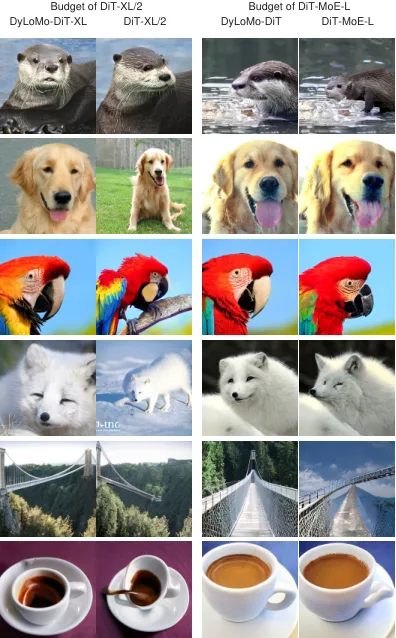
DyLoMo-DiT reuses weights in diffusion transformers for better quality per parameter
DyLoMo-DiT combines a weight-shared loop over middle layers with sparse mixture-of-experts, and varies the number of passes by noise level. The authors report lower FID than DiT and DiT-MoE on ImageNet, and a higher GenEval score than FLUX.1 with under a tenth of its active parameters.
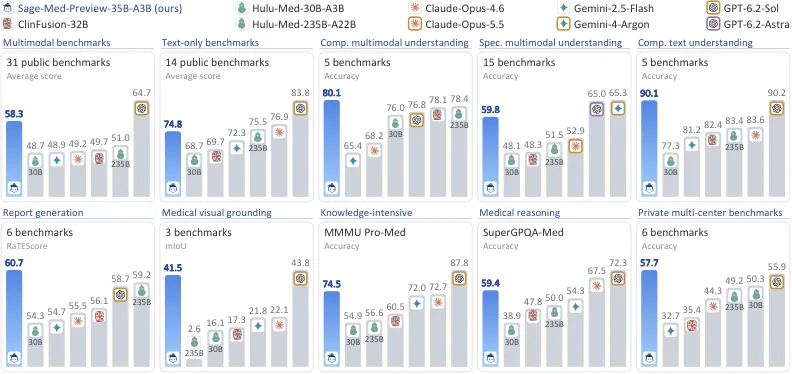
Sage-Med-Preview: 35B medical multimodal model with 3B active parameters
Researchers introduced Sage-Med-Preview, a 35B-parameter medical multimodal model with 3B activated parameters. They report it was evaluated against 77 competing models across 238 clinical tasks.
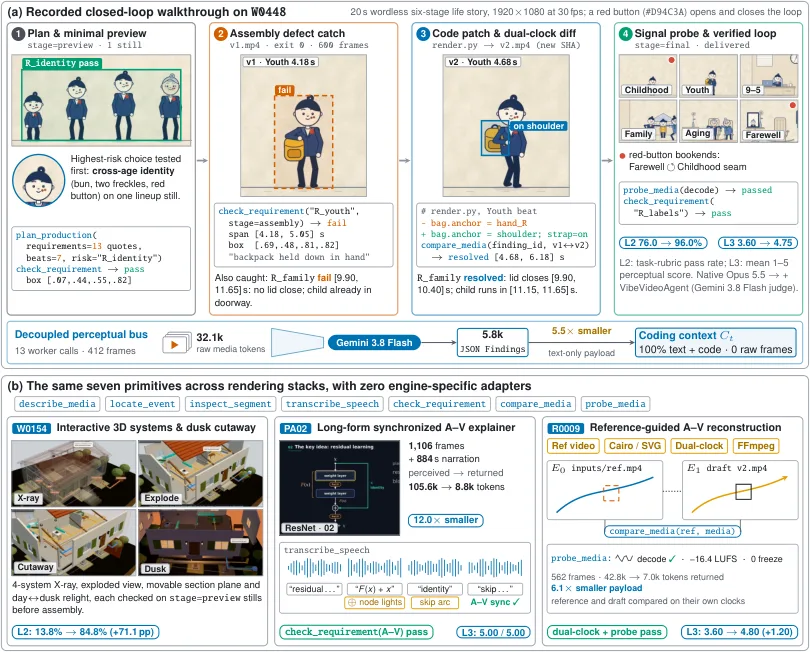
VibeVideoAgent lets coding agents inspect their own video drafts during production
VibeVideoAgent is a training-free framework for code-driven video generation. Perception runs in separate short-lived contexts and returns grounded findings to the coding agent, which helps catch issues like overlapping labels or audio drift that do not cause runtime errors.
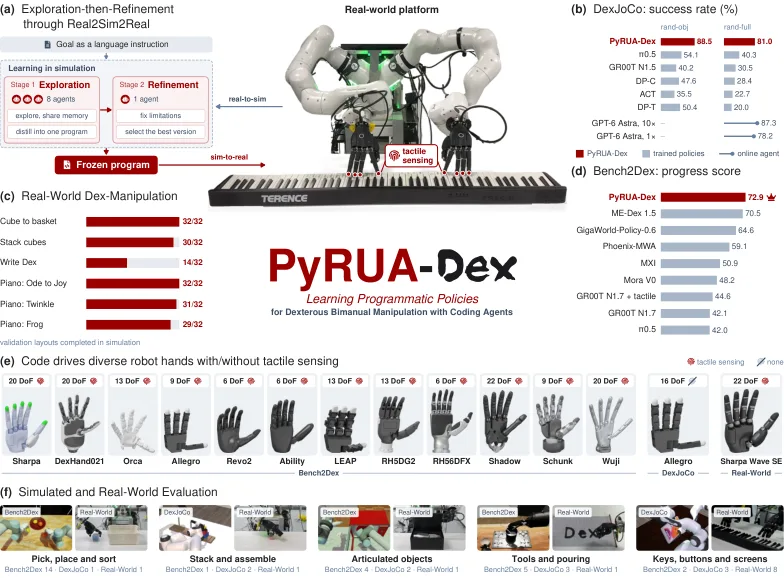
PyRUA-Dex: coding agents write programs for two-hand robot dexterity
PyRUA-Dex lets coding agents build dexterous bimanual manipulation policies as programs, without human demonstrations. The authors report state-of-the-art results on Bench2Dex and DexJoCo and show a robot playing piano and writing calligraphy.
Spotted a mistake? Email hello@capylaunch.com and we will correct it. How we make CapyLaunch TLDR News.