

Future-OPSD: self-supervised video foresight reasoning from unlabeled clips
Jingchen Sun and co-authors (Hugging Face paper page)
A paper introduces Future-OPSD, a framework that trains vision-language models to predict future events from video using past-future pairs as a self-supervised signal, without extra annotations or large external models. It also weights future information by how decision-relevant it is.
Source: huggingface.co ↗ · By CapyLaunch
Quick facts
| Base models | Qwen3-VL-8B, Qwen3.5-9B |
|---|---|
| Open-ended prediction | Up to +14.2 points over base models |
| Closed-ended planning | Up to +15.9 points over base models |
| Supervision | Unlabeled past-future video pairs, no annotations or LLM rationales |
| Code and checkpoints | Released |
What is it
Future-OPSD is a framework that teaches vision-language models to anticipate what happens next in a video. It uses past-future video pairs as a self-supervised signal, so it needs no extra annotations and no large external models. It also weights future content by how relevant it is to decisions.
How it works
The approach defines a foresight score and optimizes a tractable lower bound. It contrasts the true future with a random one to create a contrastive privilege advantage. This is combined with a teacher-student distillation advantage to amplify decision-relevant content and suppress irrelevant context.
Why it matters
Labeling video for future-event prediction is costly, so training on unlabeled footage could make this kind of feature easier to scale. The method treats most of a future clip as irrelevant context and focuses learning on the decision-relevant parts.
For builders: If you build video understanding or next-action prediction features, this approach suggests you may be able to train on unlabeled footage instead of paying for annotations.
Who + how to try
For: Builders working on video understanding or next-action prediction features who want to train on unlabeled footage.
Try:
FAQ
Does it need labeled data?
No. The paper says it uses past-future video pairs as a self-supervised signal, without extra annotations or LLM supervision.
Does it hurt general video understanding?
The paper states that Future-OPSD improves base models without compromising general video understanding.
Is the code available?
The paper page says code and checkpoints are released. The GitHub repository is listed as github.com/Jingchensun/future-opsd.
Also new this week in Research
All 8 Research stories →
Hugging Face blog: RoboTrack, point tracking for real-world robot manipulation
Hugging Face published a blog post from allenai introducing RoboTrack, a point tracking approach for robotic manipulation in real-world settings.
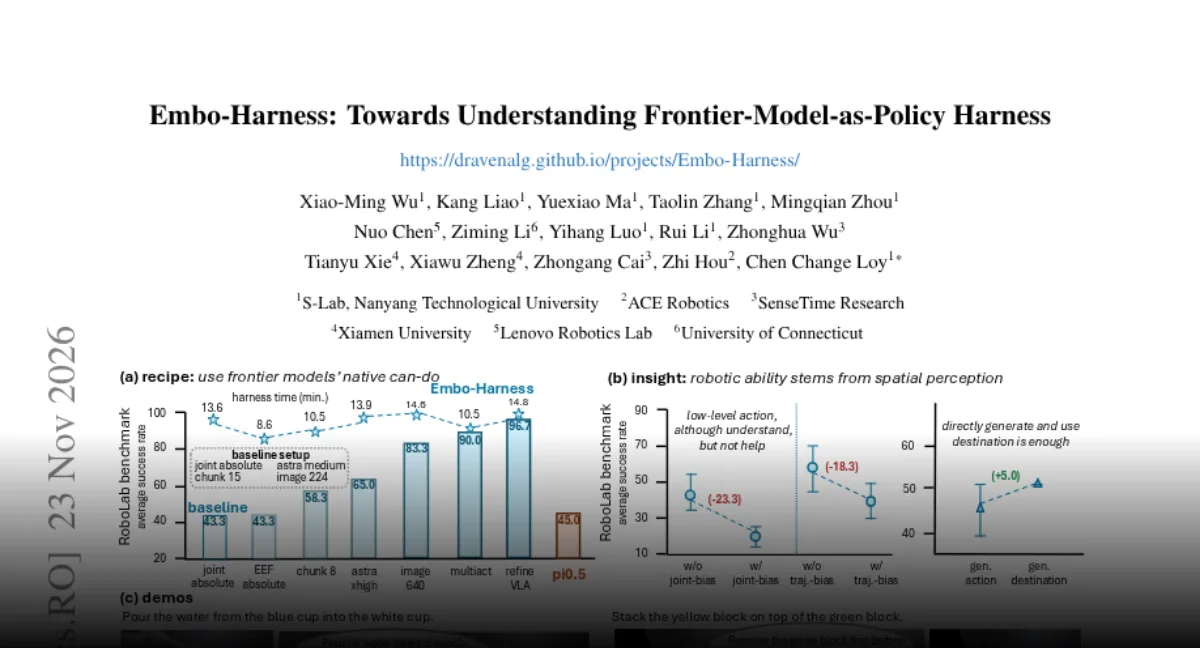
Embo-Harness: study of frontier models used directly as robot control policies
Embo-Harness is a framework for studying how frontier multimodal models can act as robot policies inside closed-loop agent loops. The authors report an 83.3% success rate on RoboLab-120, 26.2 points above the strongest reported baseline, and 15 of 20 zero-shot real-world trials.
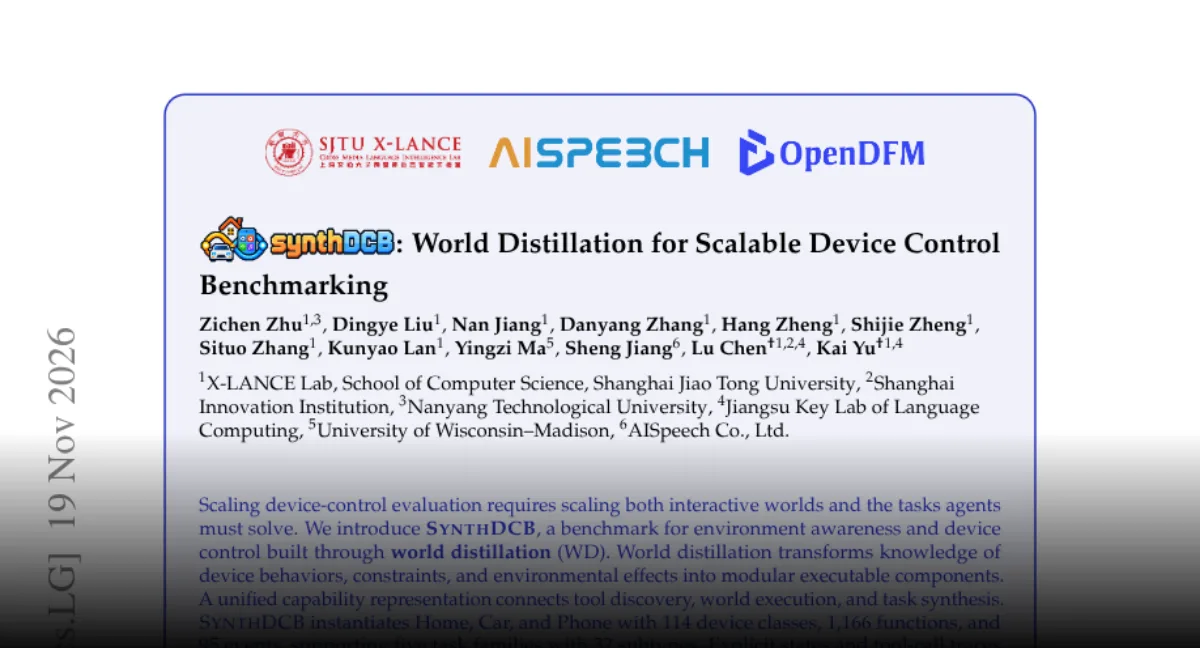
SynthDCB: benchmark for device control across home, car and phone
SynthDCB is a device-control benchmark built by converting device behaviours into executable components, covering 114 device classes and 1,166 functions. The authors evaluated 22 models on 2,560 test tasks, with the best reaching 88.8% mean Pass@1.
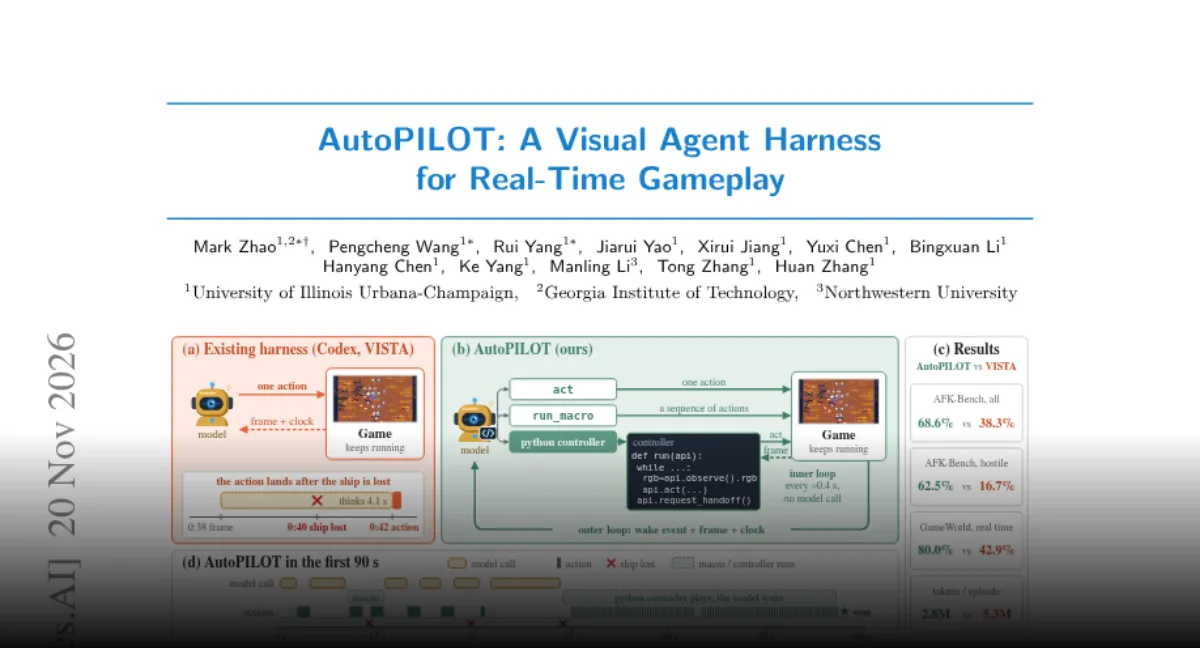
AutoPILOT: a harness that lets agents keep playing real-time games
Researchers present AutoPILOT, a visual agent harness where one model call can start a closed-loop controller that plays without further model calls. On the AFK-Bench real-time game set, it reports 68.6% success against 38.3% for VISTA using GPT-6.1 Sol.
Spotted a mistake? Email hello@capylaunch.com and we will correct it. How we make CapyLaunch News.