

ViDiHand2: geometry-driven 3D hand motion reconstruction from video
ACE Robotics
A research paper introduces ViDiHand2, which uses video diffusion model priors and geometric constraints to recover metric 3D hand motion from in-the-wild egocentric videos. It aims to generalize to unseen cameras and handle occlusion better than appearance-based depth regression.
Source: huggingface.co ↗ · By CapyLaunch
Quick facts
| Organization | ACE Robotics |
|---|---|
| Authors | Yuxi Wang, Yufei Liu, Chengkai Jin, and others (11 authors) |
| Published | 2026-11-23 |
| Speed | 57 FPS |
| Datasets | Seven public datasets |
| Baselines compared | 18 |
| Code | github.com/NTUYWANG103/ViDiHand |
What is it
ViDiHand2 is a research framework for recovering metric 3D hand motion from videos recorded in the wild, including egocentric videos. It builds on pretrained video diffusion model priors and turns hand depth estimation into geometric constraint solving. The paper is titled "ViDiHand2: Unifying Video Diffusion Priors and Hand Geometry for 3D Hand Motion Reconstruction in the Wild."
How it works
The method lifts pixel-aligned 2D joints into metric depth by matching them to the structure of MANO hands, and it uses observations across the whole clip. A Confidence-Gated Fusion step blends these geometrically lifted joints with MANO predictions based on localization confidence, which helps under occlusion and truncation. The authors also enhance the video diffusion backbone to better capture spatial-temporal features.
Why it matters
Learning robot manipulation from human videos needs accurate 3D hand motion. The authors say earlier appearance-based depth regression generalizes poorly to unseen cameras, and ViDiHand2 aims to fix that by enforcing geometric consistency. The paper reports that it outperforms 18 baselines on seven public datasets, with 42% lower in-the-wild absolute joint error and 8.82x fewer detection failures than the best baseline on each metric.
For builders: Builders working on robot learning from human video or hand tracking may find the confidence-gated fusion approach useful for handling occlusion.
Who + how to try
For: Builders working on robot learning from human video or hand tracking, especially those who need handling of occlusion.
Try:
FAQ
What problem does ViDiHand2 solve?
The authors say appearance-based depth regression from video diffusion model priors generalizes poorly to unseen cameras. ViDiHand2 recovers metric depth by enforcing geometric consistency instead.
How does it handle occlusion?
A Confidence-Gated Fusion step adaptively combines geometrically lifted joints with MANO predictions according to localization confidence, to improve robustness under occlusion and image truncation.
How fast is it and how was it tested?
The paper reports 57 FPS. Experiments on seven public datasets show it consistently outperforms 18 baselines, with 42% lower in-the-wild absolute joint error and 8.82x fewer detection failures than the best baseline on each metric.
Where can I find the code?
The paper states the code is available at https://github.com/NTUYWANG103/ViDiHand.
Also new this week in Research
All 9 Research stories →
Hugging Face blog: RoboTrack, point tracking for real-world robot manipulation
Hugging Face published a blog post from allenai introducing RoboTrack, a point tracking approach for robotic manipulation in real-world settings.
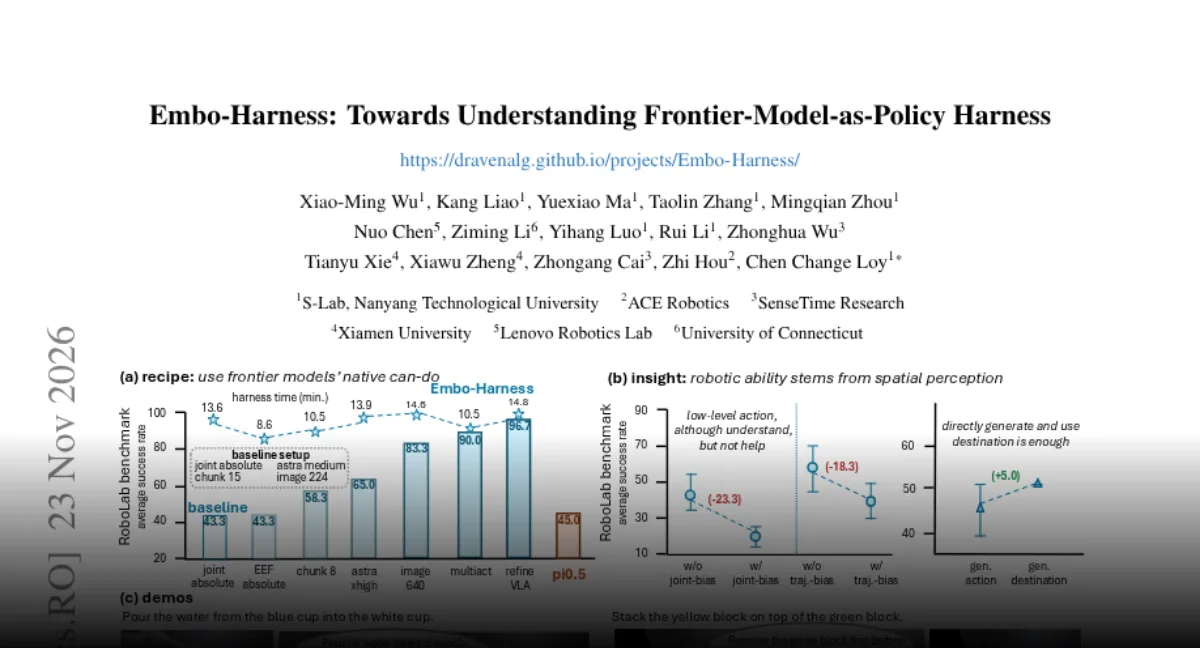
Embo-Harness: study of frontier models used directly as robot control policies
Embo-Harness is a framework for studying how frontier multimodal models can act as robot policies inside closed-loop agent loops. The authors report an 83.3% success rate on RoboLab-120, 26.2 points above the strongest reported baseline, and 15 of 20 zero-shot real-world trials.

SynthDCB: benchmark for device control across home, car and phone
SynthDCB is a device-control benchmark built by converting device behaviours into executable components, covering 114 device classes and 1,166 functions. The authors evaluated 22 models on 2,560 test tasks, with the best reaching 88.8% mean Pass@1.
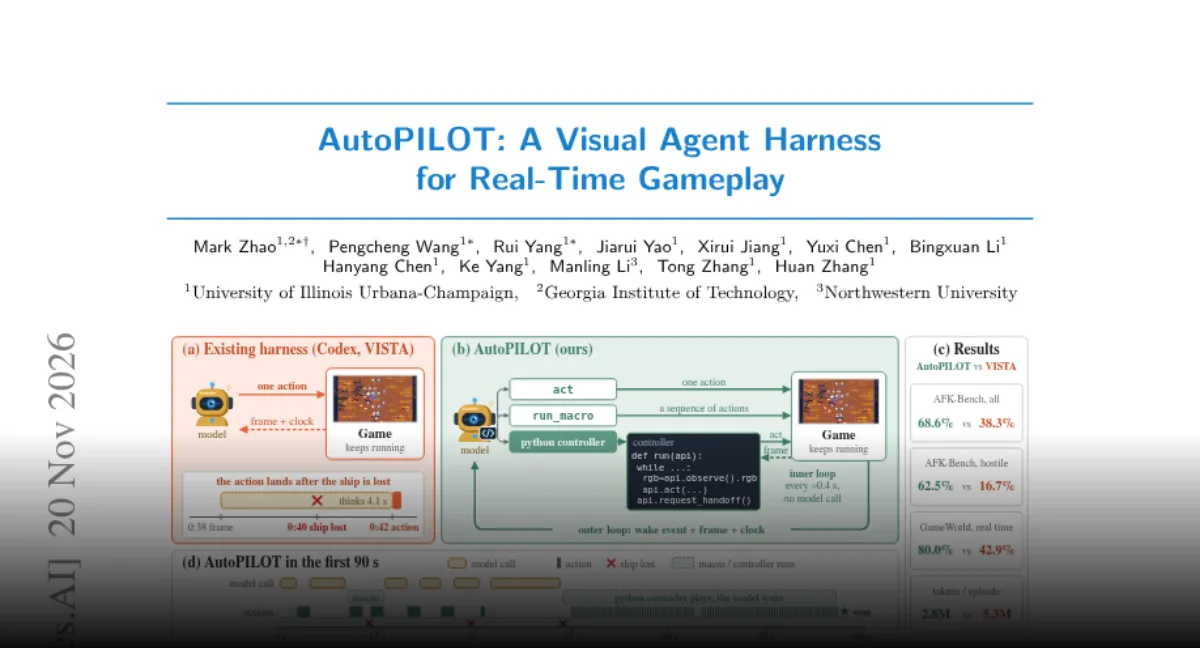
AutoPILOT: a harness that lets agents keep playing real-time games
Researchers present AutoPILOT, a visual agent harness where one model call can start a closed-loop controller that plays without further model calls. On the AFK-Bench real-time game set, it reports 68.6% success against 38.3% for VISTA using GPT-6.1 Sol.
Spotted a mistake? Email hello@capylaunch.com and we will correct it. How we make CapyLaunch TLDR News.