

ProtoCast: prototype-conditioned adaptation for interpretable weather forecasting
OliverLee520 (Hugging Face paper page author)
ProtoCast is a weather forecasting method that uses group-specific prototype banks and low-rank operators to adapt predictions to local patterns. The authors say the prototype contributions make each correction explicit and interpretable.
Source: huggingface.co ↗ · By CapyLaunch
Quick facts
| Category | Research |
|---|---|
| Paper page | Hugging Face Daily Papers |
| Project page | zhixuanli.github.io/projects/li2026protocast |
| Dataset | Released by the author on Hugging Face |
What is it
ProtoCast is a weather forecasting method. It adapts predictions to local patterns using group-specific prototype banks and low-rank operators. The authors say each prototype contribution makes the correction explicit and interpretable.
How it works
The method uses prototype banks tied to groups of data, combined with low-rank operators. Each correction is built from prototype contributions that can be read directly.
Why it matters
Many learned adjustments in forecasting models are fully implicit, which makes them hard to inspect. ProtoCast shows a way to make local corrections visible. For people building forecasting or time-series products, this points toward models whose adjustments can be examined.
For builders: If you work on forecasting or time-series models, the approach shows a way to make learned local adjustments inspectable rather than fully implicit.
Who + how to try
For: Developers and researchers working on forecasting or time-series models.
Try:
FAQ
What does ProtoCast adapt?
ProtoCast adapts weather forecasts to local patterns using group-specific prototype banks and low-rank operators.
Why do the authors say it is interpretable?
The authors say the prototype contributions make each correction explicit and interpretable.
Where can I find the dataset used in the experiments?
The author posted a comment on the paper page saying the dataset used in the ProtoCast experiments is available on Hugging Face.
Also new this week in Research
All 11 Research stories →
Simon Willison on three LLM inflection points in the past twelve months
Simon Willison wrote up a keynote he gave at the AI Engineer Code Summit, arguing that LLMs and coding agents have hit three major inflection points in the past year. He uses the November 2025 release of Claude Opus 4.5 as a key example.
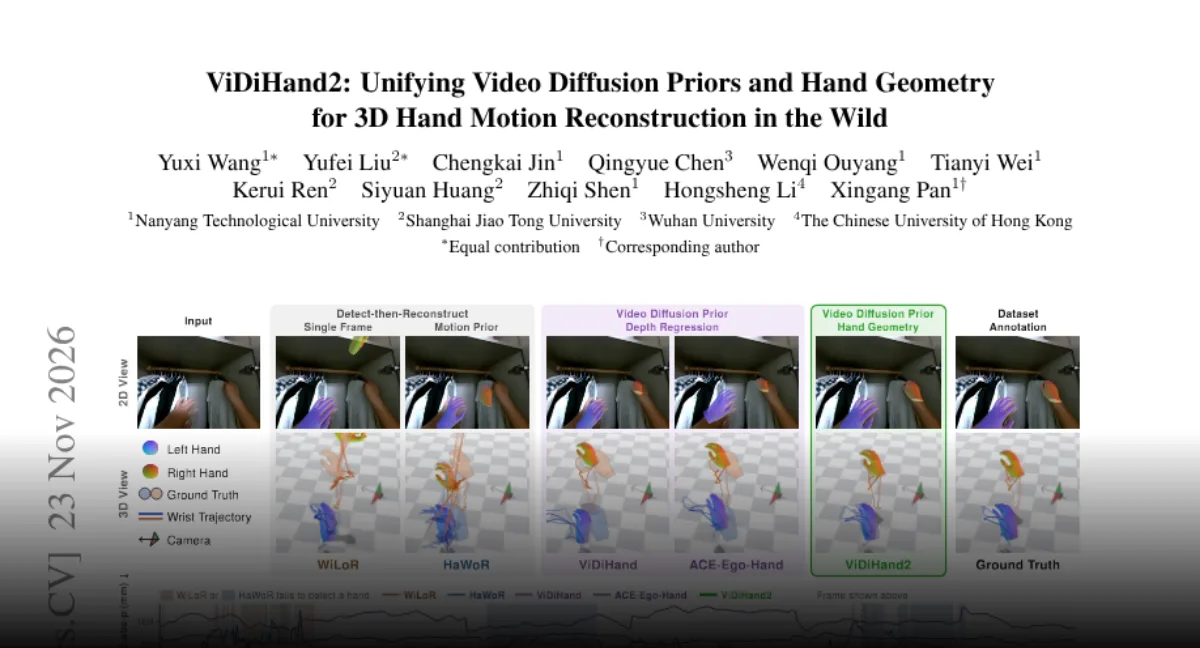
ViDiHand2: geometry-driven 3D hand motion reconstruction from video
A research paper introduces ViDiHand2, which uses video diffusion model priors and geometric constraints to recover metric 3D hand motion from in-the-wild egocentric videos. It aims to generalize to unseen cameras and handle occlusion better than appearance-based depth regression.

Hugging Face blog: RoboTrack, point tracking for real-world robot manipulation
Hugging Face published a blog post from allenai introducing RoboTrack, a point tracking approach for robotic manipulation in real-world settings.
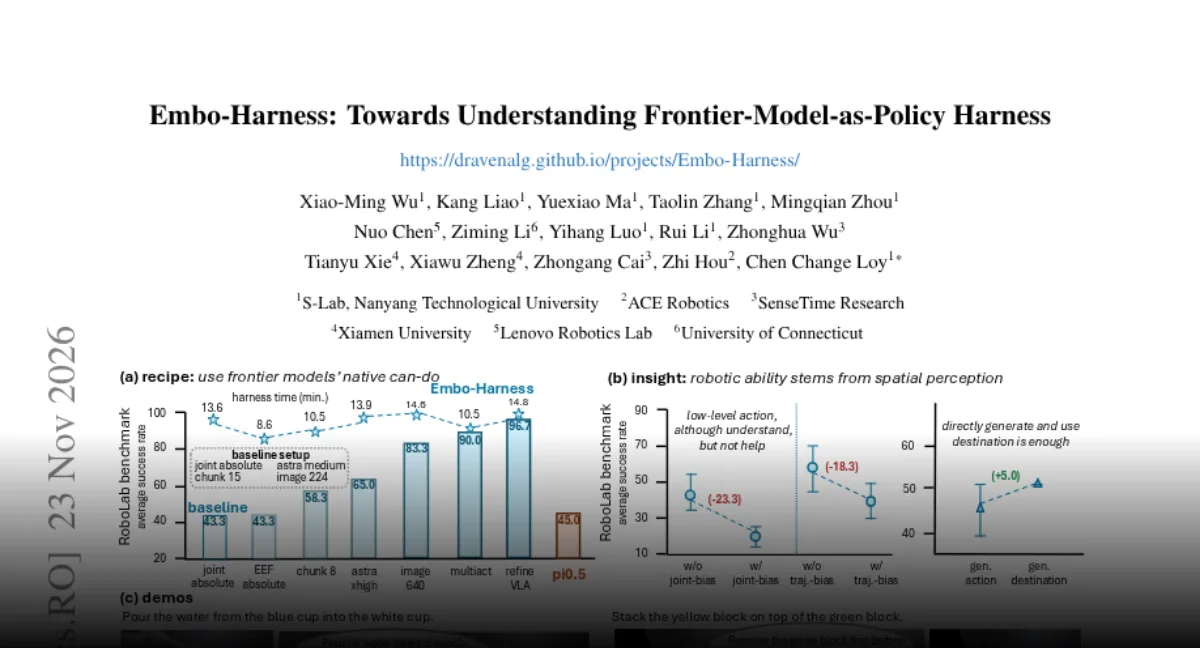
Embo-Harness: study of frontier models used directly as robot control policies
Embo-Harness is a framework for studying how frontier multimodal models can act as robot policies inside closed-loop agent loops. The authors report an 83.3% success rate on RoboLab-120, 26.2 points above the strongest reported baseline, and 15 of 20 zero-shot real-world trials.
Spotted a mistake? Email hello@capylaunch.com and we will correct it. How we make CapyLaunch TLDR News.