

Simon Willison on three LLM inflection points in the past twelve months
Simon Willison
Simon Willison wrote up a keynote he gave at the AI Engineer Code Summit, arguing that LLMs and coding agents have hit three major inflection points in the past year. He uses the November 2025 release of Claude Opus 4.5 as a key example.
Source: simonwillison.net ↗ · By CapyLaunch
Quick facts
| Author | Simon Willison |
|---|---|
| Post date | 24 November 2026 |
| Key model | Claude Opus 4.5, released November 2025 |
| Event | AI Engineer Code Summit keynote |
What is it
Simon Willison is a developer and writer who posted a write-up of a keynote he gave at the AI Engineer Code Summit. The talk argues that LLMs and coding agents have passed three major inflection points in the past twelve months. The post pulls out the inflection point theme and looks at it more closely.
How it works
Willison describes a shift from models that needed constant correction to models that handle tasks without hand-holding. He calls newer frontier models Fable class and says they can be given a goal and the right tools to work toward it. He also notes that recent models have become strong at 3D modeling when given Blender or Three.js.
Why it matters
For people building products on coding agents, the post offers a timeline for when these tools became reliable enough to depend on. Willison says Claude Opus 4.5, released in November 2025, was the first model where the default result was generally the right thing. Builders can use that timeline to judge when agent-based workflows became practical.
For builders: The post and talk offer a useful timeline for deciding when coding agents became reliable enough to build products around.
Who + how to try
For: Developers, indie makers and founders who are deciding whether coding agents are ready to build products around.
Try:
https://simonwillison.net/2026/Nov/24/llm-inflection-points/
FAQ
What are the three inflection points?
The source describes the talk as built around three significant inflection points in LLM and coding agent abilities over the past twelve months. The post pulls out the coding agent theme in detail. The other two are not fully described in the source text provided.
Why does Willison single out Claude Opus 4.5?
He says Opus 4.5 was the first model he used with Claude Code where the default result was generally the right thing. Before it, he had to correct Claude Code often enough that it did not feel like a clear accelerant.
What is a Fable class model?
Willison uses the term for models that are relentlessly proactive and work well when given a goal and the right tools. He gives an example where a model fixed a Safari display glitch by building its own screenshot mechanism and a logging server.
Are frontier models good at 3D modeling now?
According to Willison, recent frontier LLMs produce credible 3D models when set up with Blender or asked to write Three.js code. He says this got much better over the past few months.
Also new this week in Research
All 10 Research stories →
ViDiHand2: geometry-driven 3D hand motion reconstruction from video
A research paper introduces ViDiHand2, which uses video diffusion model priors and geometric constraints to recover metric 3D hand motion from in-the-wild egocentric videos. It aims to generalize to unseen cameras and handle occlusion better than appearance-based depth regression.

Hugging Face blog: RoboTrack, point tracking for real-world robot manipulation
Hugging Face published a blog post from allenai introducing RoboTrack, a point tracking approach for robotic manipulation in real-world settings.
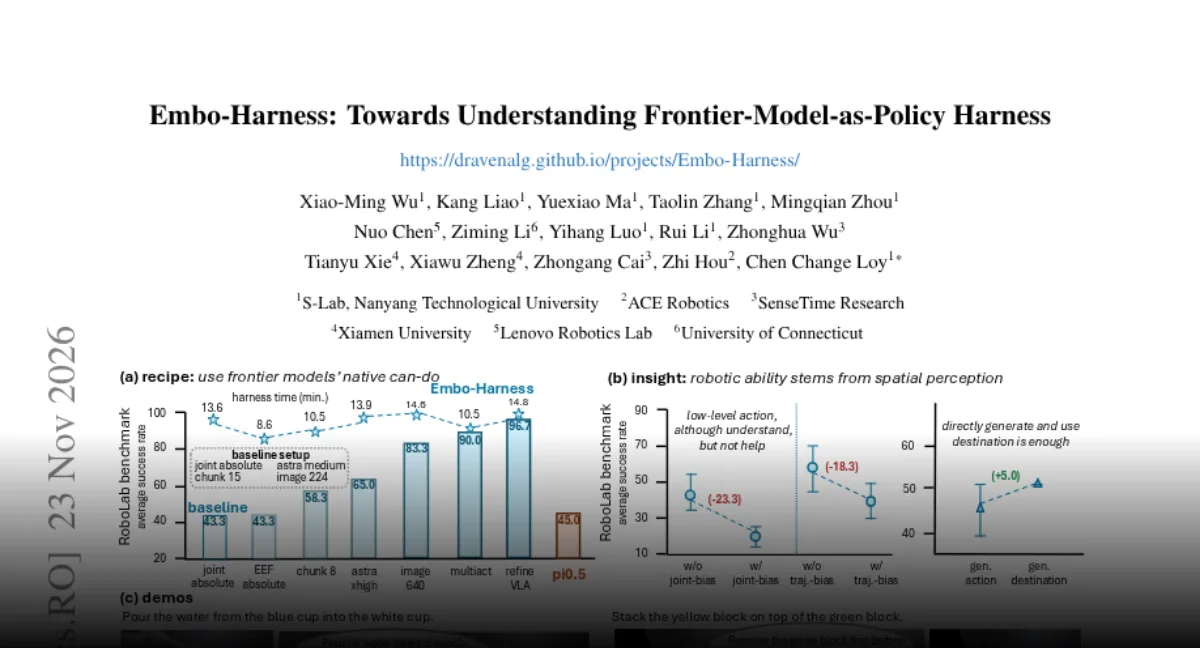
Embo-Harness: study of frontier models used directly as robot control policies
Embo-Harness is a framework for studying how frontier multimodal models can act as robot policies inside closed-loop agent loops. The authors report an 83.3% success rate on RoboLab-120, 26.2 points above the strongest reported baseline, and 15 of 20 zero-shot real-world trials.

SynthDCB: benchmark for device control across home, car and phone
SynthDCB is a device-control benchmark built by converting device behaviours into executable components, covering 114 device classes and 1,166 functions. The authors evaluated 22 models on 2,560 test tasks, with the best reaching 88.8% mean Pass@1.
Spotted a mistake? Email hello@capylaunch.com and we will correct it. How we make CapyLaunch TLDR News.